Tourism Sector Rebounds Driving 2023 Economic Growth

Tourism Sector Rebounds Driving 2023 Economic Growth

Sri Lanka’s tourism industry is bouncing back in 2023, despite recent challenges. The sector employs nearly half a million people directly. It also supports millions more indirectly.

Recent data shows tourist arrivals more than doubled in 2022, reaching 1.5 million. Early signs suggest Sri Lanka may outpace the Maldives as a top destination.

International tourists are flocking to Sri Lanka’s natural beauty and rich culture. Domestic tourism is also on the rise. Locals are rediscovering their country’s wonders.

This boost in tourism, both international and domestic, is set to fuel Sri Lanka’s economic recovery. The hospitality sector’s growth is expected to play a key role in 2023.

Key Takeaways

  • Sri Lanka’s tourism sector is showing strong signs of recovery in 2023, despite recent challenges
  • Tourist arrivals more than doubled in 2022 compared to 2021, reaching 1.5 million
  • Sri Lanka is on track to surpass the Maldives as a top tourist destination in 2023
  • The travel industry revival is driven by both international tourism trends and a boost in domestic tourism
  • The hospitality sector growth is expected to contribute significantly to Sri Lanka’s economic recovery in 2023

Sri Lanka’s Tourism Industry Poised for Recovery

Sri Lanka’s tourism sector is bouncing back in 2023. Tourist arrivals and spending have increased significantly. From January to August, 904,318 visitors came, surpassing 2022’s total arrivals.

This surge has boosted the economy. Tourism receipts reached US$1,136.30 million in 2022. In the first half of 2023, they hit US$875 million. This economic impact is notable.

Increased Tourist Arrivals and Spending in 2023

Visitors from various regions are driving the recovery. Sri Lankan Airlines, Qatar Airways, and Emirates led market shares in 2022. This shows strong demand for travel to Sri Lanka.

The economy grew 5 percent in early 2024. This growth came from tourism-related services and industry. Construction and food manufacturing also contributed.

International Airlines Resume Operations to Sri Lanka

Many international airlines have resumed full-time operations to Sri Lanka. Qatar Airways, Singapore Airlines, and Emirates are back. Thai AirAsia, Air China, and Air France have started new routes.

This increased connectivity boosts tourist arrivals. It also creates more tourism employment opportunities.

Cruise Tourism Shows Promising Growth

Cruise tourism is gaining interest. Various cruise lines are choosing Sri Lanka as a destination. March 2024 is expected to be busy for cruise arrivals.

The industry’s recovery continues. The government and private sector focus on sustainable tourism. This approach aims to ensure long-term growth and development.

Tourism Sector Rebounds, Contributing to Economic Recovery in 2023

Sri Lanka’s tourism sector is bouncing back, fueling economic growth in 2023. It’s now the third largest foreign exchange earner, creating jobs and boosting the economy. In 2023, Sri Lanka welcomed 1,487,303 tourists, doubling the previous year’s numbers.

Europe and Asia-Pacific regions brought in most visitors. This aligns with global trends, as international tourism hit 88% of pre-pandemic levels. The World Tourism Organization expects full recovery by 2024.

Sri Lanka’s tourism outlook is promising. The government and businesses are investing in luxury hotels. They’re also promoting destinations to high-spending tourists from Europe and other regions.

These efforts aim to increase foreign exchange earnings. Tourism businesses keep most earnings within the country. This helps drive economic recovery and create jobs.

The sector shows resilience despite global economic challenges. Air passenger numbers and hotel occupancy are rising. This proves tourism’s potential to boost economic growth.

Sri Lanka continues to improve its tourism infrastructure. It’s also promoting unique attractions. These actions position tourism as a key player in the country’s economic recovery.

Government Initiatives and Private Sector Investments Fuel Tourism Growth

Sri Lanka’s government is offering beachfronts and islets for tourism development. They’re encouraging public-private partnerships to boost investment and expertise. This strategy aims to drive economic recovery through tourism infrastructure development.

Private investors are jumping into the resurgent tourism market. Hotelier Angeline Ondaatje is building luxury hotels for high-end European travelers. These hotels focus on Buddhist spirituality and Ayurvedic medicine.

Experts suggest the Tourism Board launch targeted marketing campaigns in Europe. They should highlight Sri Lanka’s unique attractions. These include world-class surfing at Arugam Bay and abundant wildlife sanctuaries.

Sri Lanka’s tourism sector is ready for a strong comeback. The country can use its natural and cultural assets to boost the economy. This growth can create new opportunities across the island nation.

World Bank Projects 4.4% Growth for Sri Lanka in 2024

World Bank Projects 4.4% Growth for Sri Lanka in 2024

The World Bank foresees a 4.4% growth for Sri Lanka’s economy in 2024. This positive outlook follows four quarters of growth. The industrial and tourism sectors are driving this progress. Check out the economic forecast for more details.

Sri Lanka’s economy has shown signs of stabilization, surpassing earlier estimates. However, the recovery remains fragile. It depends on maintaining stability, restructuring debt, and pursuing reforms.

Sri Lanka has $10 billion in untapped export potential annually, mainly in Asia. This could create about 142,500 new jobs. The World Bank suggests reducing tariffs and improving efficiency to boost exports.

Despite growth projections, poverty levels may stay above 20% until 2026. Inflation is expected to remain below 5% in 2024. The current account should stay in surplus, thanks to tourism and remittances.

Key Takeaways

  • The World Bank projects Sri Lanka’s economy to grow by 4.4% in 2024, driven by the industrial and tourism sectors.
  • Sri Lanka’s untapped export potential is estimated at $10 billion annually, which could create around 142,500 new jobs.
  • The recovery remains fragile and depends on maintaining macroeconomic stability, restructuring debt, and pursuing further reforms.
  • Poverty levels are expected to remain above 20% until 2026, despite the positive growth outlook.
  • Inflation is anticipated to stay below the Central Bank’s target of 5% in 2024, and the current account is forecasted to remain in surplus.

Sri Lanka’s Economy Stabilizes with Positive Growth Outlook

Sri Lanka’s economy is on the mend. The World Bank predicts a 4.4% growth rate in 2024. This follows four quarters of growth, led by industrial and tourism sectors.

The recovery stems from successful fiscal policies and debt restructuring. These efforts have stabilized the economy and drawn foreign investment.

Four Consecutive Quarters of Growth Driven by Industrial and Tourism Sectors

Industrial and tourism sectors have fueled Sri Lanka’s economic comeback. Tourism has rebounded as international visitors return to the island nation. The government’s promotion of Sri Lanka as a safe destination has boosted tourism revenue.

World Bank Warns Recovery Remains Fragile and Dependent on Reforms

The World Bank cautions that Sri Lanka’s recovery is still fragile. It depends on continuing structural reforms. The country must maintain stability, restructure debt, and implement growth-boosting reforms.

Sri Lanka could increase export revenues by $10 billion yearly. This could create about 142,500 new jobs. Diversifying the economy and promoting sustainable growth are crucial.

The World Bank expects growth to slow to 3.5% in 2025 and 3.1% in 2026. This highlights the need for ongoing economic strengthening efforts.

Sri Lanka’s growth lags behind the 6.4% projected for South Asian economies. However, Sri Lanka’s commitment to recovery is clear from recent progress.

Focusing on women’s labor participation and global trade opportunities can boost growth. This will help Sri Lanka contribute to the region’s economic success.

Key Reforms Necessary to Boost Exports and Attract Foreign Investment

Sri Lanka aims to capitalize on its projected 4.4% economic growth in 2024. The World Bank report highlights the need for reforms to unlock $10 billion in export potential. Diversifying exports could create 142,500 new jobs, boosting the economy and reducing poverty.

Poverty rates are expected to remain above 20% until 2026. Reforms are crucial to attract foreign investment and create new opportunities. Sri Lanka must remove bureaucratic obstacles and level the playing field for investors.

Sri Lanka’s Untapped Export Potential Estimated at $10 billion Annually

To leverage its export potential, Sri Lanka must implement crucial reforms. These changes aim to attract foreign investment and create new jobs. The World Bank suggests streamlining processes and fostering an investor-friendly environment.

Diversifying Exports Across Manufacturing, Services, and Agriculture Crucial

Sri Lanka must focus on diversifying its exports across various sectors. This strategy will create a more resilient economy and new job opportunities. The report emphasizes increasing female labor force participation to drive inclusive growth.

Seylan Bank’s strong financial performance shows potential growth in the financial sector. This can support export-oriented businesses and contribute to overall economic development.

Removing Bureaucratic Obstacles and Creating Level Playing Field for Investors

Sri Lanka must address challenges like poverty, food insecurity, and financial sector vulnerabilities. Implementing targeted reforms and investing in education, healthcare, and infrastructure is crucial. These actions will create a better environment for businesses and ensure shared economic growth.

Embracing these critical reforms is essential for Sri Lanka’s future. They will unlock the country’s full economic potential and create a brighter future for its citizens.

Sri Lankan Education Reforms Promise Major Progress

Sri Lankan Education Reforms Promise Major Progress

Sri Lanka is set for major educational changes. Presidential candidates pledge to improve learning outcomes. President Wickremesinghe plans vocational training and university expansion, while Premadasa focuses on teacher support and smart schools.

Anura Kumara Dissanayake, NPP leader, prioritizes early childhood development. He aims to ensure equal access to education for all. The NPP gained three seats in the 2020 election, with Dissanayake receiving 42.31% of votes.

These reforms introduce innovative teaching methods and integrate technology. They focus on improving English skills and simplifying exams. Comprehensive teacher training is also a key aspect of these changes.

Statistics show high graduate unemployment rates across provinces. University admission disparities are also evident. The per capita cost of education has risen sharply since 2000.

These figures highlight the need for sustainable financing in higher education. Educational reforms are crucial for Sri Lanka’s progress. They promise to address these challenges and improve the overall system.

Presidential Candidates Pledge Comprehensive Education Reforms

Sri Lanka’s presidential candidates have unveiled plans for education reforms. Their focus includes vocational training, university expansion, and free teacher transportation. They also aim for smart schools, early childhood development, and equal education access.

President Ranil Wickremesinghe’s Plans for Vocational Training and University Expansion

President Wickremesinghe plans to establish Vocational Skills Sri Lanka by 2025. This will streamline training and help students gain workforce skills.

He also aims to open Technical and Vocational Management University Colleges in all provinces. This will expand higher education access across the country.

Sajith Premadasa’s Focus on Free Transportation for Teachers and Smart Schools

Sajith Premadasa pledges free public transportation for all teachers. He recognizes their crucial role in shaping the nation’s future.

Premadasa plans to transform every school into a smart school. These schools will have electricity, water facilities, and physical resources.

Anura Kumara Dissanayake’s Commitment to Early Childhood Development and Equal Access

Anura Kumara Dissanayake proposes early childhood centers near workplaces or homes. These centers will support children’s physical and psychological growth.

Dissanayake advocates for equal education access. He wants all children to receive quality education, regardless of their background.

These reforms aim to address Sri Lanka’s education system challenges. They could improve the lives of students and teachers across the country.

Transforming Schools into Smart Learning Environments

Sri Lankan presidential candidates propose innovative initiatives to transform schools into smart learning environments. The global market for smart education is expected to reach USD 586.04 billion by 2021. These reforms aim to use technology to enhance learning for students nationwide.

Expanding the ‘Sakwala’ Program for Digital Learning Platforms

Sajith Premadasa’s manifesto prioritizes expanding the ‘Sakwala’ program for digital learning in schools. This initiative will extend to technical, vocational institutions, and universities. It will make quality education more affordable and accessible.

Students will engage in interactive and personalized learning experiences. This approach will prepare them for the challenges of the 21st century.

Establishing a School Twinning Program for Global Partnerships

Premadasa proposes a school twinning program to foster global partnerships. This initiative will encourage collaborative learning between schools worldwide. Students will interact with peers from different cultures, broadening their horizons.

Mandating School Trust Funds for Facility Maintenance and Sustainability

Premadasa plans to mandate school trust funds supported by local communities. These funds will ensure regular maintenance of school infrastructure. Investing in school facilities aims to create better learning spaces for students.

Sri Lanka’s journey towards smart learning environments requires careful planning. It’s crucial to consider best practices from organizations like the International Standards Organization (ISO). Leveraging expertise from tech companies and researchers will ensure effective implementation of these reforms.

Curriculum Restructuring and Teacher Training Initiatives

The government proposes curriculum restructuring and assessment reforms to address learning burdens and education gaps. These initiatives aim to streamline students’ educational experience and align content with 21st-century needs. The focus is on making education more relevant and manageable for students.

A key proposal is implementing STEEAM education, emphasizing Science, Technology, English, Engineering, Arts, and Mathematics. The government plans to expedite teacher training activities. This will equip educators with skills to deliver the new curriculum effectively.

Simplifying the Grade 5 Scholarship Examination

The Grade 5 Scholarship Examination causes significant stress for children. The government plans to simplify and restructure this assessment. This change aims to reduce pressure on young students while still rewarding academic excellence.

Enhancing Early Childhood Education

Early childhood education accreditation is a priority for the government. Plans include establishing a regulatory authority and upgrading infrastructure. The focus is on creating child-friendly, modern learning environments.

Teacher training programs will be enhanced to support these changes. The government also aims to engage parents in the education process. This will create a supportive environment for young learners.

Focusing on English Language Skills

The government plans to enhance English language skills from an early stage. This will prepare students for success in a globalized world. English learning will be integrated throughout the primary and secondary curriculum.

Significant Advancements in Education Expected Through Current Reforms

Sri Lanka’s education sector is set for major improvements. President Ranil Wickremesinghe plans to establish a National Higher Education Authority. This body will research global education reforms and allocate funds to education sectors.

These initiatives aim to boost education quality and meet international standards. The reforms focus on modern learning methods and better infrastructure. The ‘Sakwala’ program will expand digital learning platforms.

A school twinning program will create global partnerships. Mandated School Trust Funds will maintain school facilities. This will create better learning environments for students.

Curriculum restructuring and teacher training are key reform areas. STEEAM education will focus on Science, Technology, English, Engineering, Arts, and Mathematics. This approach will equip students with essential modern skills.

The Grade 5 Scholarship Exam will be simplified. Early childhood educators will receive comprehensive training and accreditation. These changes will improve education quality at all levels.

The government is increasing university enrollment and expanding National Colleges of Education. They’re recruiting language teachers skilled in various foreign languages. Lecturers and professors from abroad are being brought back.

Sri Lanka is embracing e-learning, blockchain technology, and AI in education. These advancements will prepare students for the changing global landscape. The improved educational outcomes will benefit the nation’s future workforce.

FAQ

What are the key focus areas of the proposed education reforms in Sri Lanka?

Sri Lanka’s education reforms focus on several key areas. These include vocational training, university expansion, and free teacher transportation. The reforms also aim to create smart learning environments and ensure equal access to education.

How does President Ranil Wickremesinghe plan to improve vocational training in Sri Lanka?

President Wickremesinghe plans to establish Vocational Skills Sri Lanka (VSSL) by 2025. This new entity will combine existing training authorities. He also aims to open Technical and Vocational Management University Colleges in all provinces.

What are Sajith Premadasa’s key proposals for enhancing the education system?

Premadasa promises free public transport for all teachers. He plans to transform schools into smart learning spaces with modern facilities. His proposals include expanding digital learning platforms and creating global school partnerships.

How does Anura Kumara Dissanayake plan to support early childhood development?

Dissanayake focuses on early childhood development centers near workplaces or homes. He aims to create environments that support children’s physical and psychological growth.

What is the proposed STEEAM education system, and how will it be implemented?

STEEAM stands for Science, Technology, English, Engineering, Arts, and Mathematics. Premadasa’s plan prioritizes these subjects in all schools. The system will be implemented by fast-tracking teacher training activities.

How will the proposed education reforms address the mental stress caused by the Grade 5 Scholarship Examination?

Premadasa suggests simplifying the Grade 5 Scholarship Examination. This change aims to reduce the immense mental stress on children. The goal is to make the exam less pressurizing for students.

What improvements are planned for Early Childhood Education (ECE) in Sri Lanka?

The reforms include creating an ECE regulatory authority. They also focus on upgrading child-friendly infrastructure and enhancing teacher training. Promoting parental engagement is another key aspect of the planned improvements.

How will the education reforms help Sri Lankan students compete globally?

The reforms introduce modern learning methods and improved infrastructure. They focus on key subjects like science, technology, and English. These changes aim to equip students with skills needed for global success.
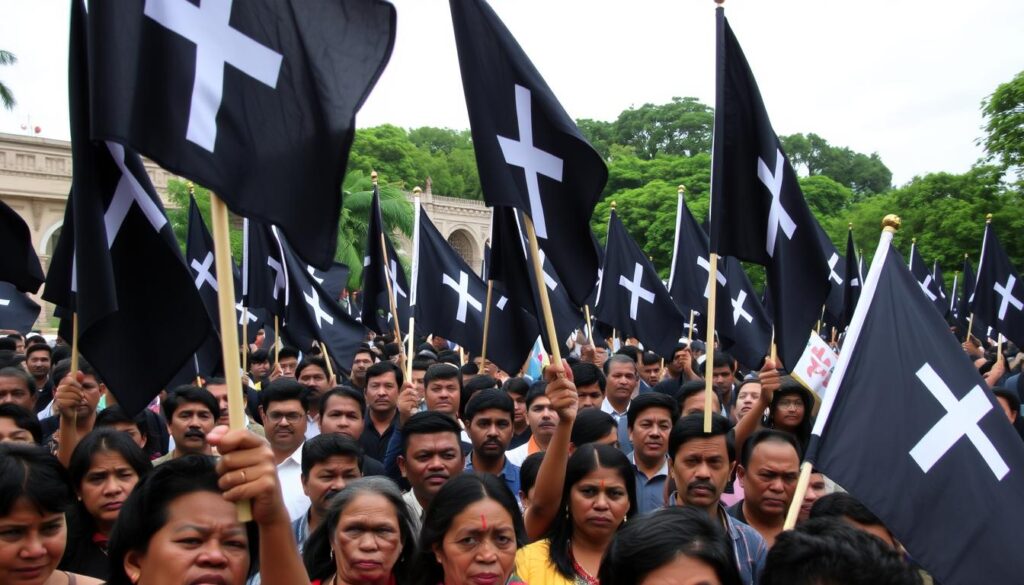

Sri Lanka Christians Wave Black Flags to Protest Bombing Probe

Sri Lanka Christians Wave Black Flags to Protest Bombing Probe

With black flags, Sri Lanka Christians protest bombing probe

Christians in Sri Lanka chose a silent way to protest. They raised black flags at churches and homes. This action showed their frustration with the slow investigation into the Easter bombings. These bombings killed 269 people. Cardinal Malcolm Ranjith led this protest. He suggests that the real planners behind the attack might still be free.

At St. Sebastian’s Church in Negombo, the pain is deep. Many here lost loved ones. Manilal Ranasinghe criticizes the government for ignoring warnings. During the demonstration, Muslims also showed support by displaying black flags. This unity shows Sri Lanka’s strength in fighting terror.

Key Takeaways

  • Sri Lanka’s Christians show dissent through nationwide black flag protest.
  • Questioning of the integrity and thoroughness of the government’s bombing probe.
  • Cardinal Malcolm Ranjith has voiced suspicion over the arrests relating to the bombings.
  • Communities across religious lines in Sri Lanka showcase solidarity amidst tragedy.
  • Increased security measures enforced in response to the threat of terrorism.

Overview of the Easter Sunday Bombings and Subsequent Protests

On Easter Sunday, April 21, 2019, Sri Lanka faced chaos. This was because of suicide bombings by ISIS-inspired groups. National Thowheeth Jama’ath and Jammiyathul Millathu Ibrahim were behind it. They attacked Christian churches and luxury hotels in Colombo. This violence killed 270 people, including worshippers and foreigners, and hurt over 500.

This was the deadliest violence in Sri Lanka since 2009. The peace of a sacred holiday was destroyed for many. It reminded people of past conflicts.

Sectarian tensions grew after the bombings against the Muslim community. These people, making up 10% of the population, faced violence and boycotts. Despite warnings, the government’s response was slow due to issues and inefficiencies. This led to more trouble.

The Christian communities in Sri Lanka protested in response. They mourned their losses by waving black flags and demanded justice. These actions showed their pain and the need for better security.

The Sri Lankan Supreme Court pointed out serious governmental mistakes. These included inaction by the then-President Maithripala Sirisena despite prior warnings. This criticism has sparked widespread demand for improved security and accountability.

Aspect Details
Incident Date Easter Sunday, April 21, 2019
Locations Affected Christian churches and luxury hotels in Colombo, Sri Lanka
Casualties 270 dead, over 500 injured
Perpetrators Local Islamist extremist groups inspired by ISIS
Public Response Protests, waving of black flags by Christians
Government and Legal Response Judicial reprimand, call for security reforms

For more on Sri Lanka’s socio-economic stability, visit Sri Lanka’s economic crisis and recovery

With black flags, Sri Lanka Christians protest bombing probe

After the Easter Sunday attacks in 2019, Sri Lanka’s Christians are demanding justice. They’ve raised black flags as a symbol of their protest. This act comes as twenty-five people were recently charged for the bombings. These developments question the government’s investigation efforts.

About 7% of Sri Lanka’s population is Christian, mainly in areas like Negombo. This community was hard hit by the attacks, which claimed 269 lives. The attacks targeted them heavily, showing the risk they face in a country of diverse religions.

Sri Lanka’s Religious Demographics and Christian Minority

Christianity in Sri Lanka is mostly made up of Roman Catholics. This community, though small, was greatly affected by attacks on churches and hotels. It was the first major terror event since the Civil War ended in 2009. Such violence showed the religious group’s vulnerability among Buddhists, Hindus, and Muslims.

Accusations of Government Inaction and Political Conspiracy Allegations

The attack’s impact was profound, revealing political conspiracies. It highlighted a lack of cooperation between key leaders at the time. This resulted in missed warnings from foreign intelligence.

In Negombo, Christians gathered silently at St. Sebastian’s Church, waving black flags. They’re calling for action and measures to prevent future violence. Their protest shows they want those in power to take responsibility seriously.

Solidarity Across Communities in the Face of Tragedy

Despite being a minority, Christians saw support from other faiths after the bombings. Muslims and Christians united, raising black flags in grief. This act was a stand against the extremism that caused the tragedy.

Community bells rang at 8:45 a.m., marking the moment the tragedy began. This gesture called for peace and showed the community’s resilience. It’s a plea for respect and understanding among different faiths, aiming for a peaceful coexistence.

Central Bank Digital Banking Framework Boosts Inclusion

Central Bank Digital Banking Framework Boosts Inclusion

Sri Lanka’s Central Bank Digital Banking Framework aims to boost financial inclusion. It uses digital tech and innovative payment solutions. The goal is to bring unbanked people into the formal financial system.

The framework supports fintech innovations and digital payment systems. It promotes interoperability among platforms and strengthens consumer protection. These efforts build trust and encourage adoption of digital banking services.

Central Bank Introduces Digital Banking Framework to Enhance Financial Inclusion

Success depends on a strong payment system infrastructure. This ensures smooth integration between traditional and digital banking. Collaboration among financial institutions, tech providers, and regulators is vital.

The framework empowers citizens with affordable, convenient financial services. It bridges the digital divide and promotes financial literacy. This initiative can uplift lives and boost economic growth.

Key Takeaways

  • The Central Bank Digital Banking Framework aims to enhance financial inclusion in Sri Lanka through digital technologies and innovative payment solutions.
  • The framework creates a supportive environment for fintech innovations, promoting interoperability and strengthening consumer protection.
  • Establishing a robust payment system infrastructure is crucial for the success of the digital banking framework.
  • Collaboration among stakeholders is essential in driving the digital transformation of the banking sector.
  • The initiative has the potential to empower citizens with access to affordable and convenient financial services, contributing to economic growth.

Central Bank Introduces Digital Banking Framework to Enhance Financial Inclusion

Sri Lanka’s Central Bank has launched a new digital banking framework. This move aims to boost financial inclusion and drive economic growth. The framework encourages innovation while protecting consumers and maintaining financial stability.

The Role of Central Bank Digital Currency (CBDC) in Promoting Financial Inclusion

CBDCs offer a safe, digital way to pay. They can help more people join the formal financial system. A 2022 BIS survey shows 93% of central banks are exploring CBDCs.

The Central Bank of Sri Lanka’s framework paves the way for CBDC adoption. This could greatly improve financial inclusion efforts in the country.

digital banking framework

India’s Progress in Digital Payment Systems and Its Impact on CBDC Implementation

India’s success with digital payments offers valuable lessons for Sri Lanka. Mobile wallets and telco-based systems are widely used in India. This success could smooth the way for CBDC implementation.

Most central banks see value in having both fast payment systems and CBDCs. Sri Lanka can learn from India as it moves towards a cashless society.

Addressing Challenges in CBDC Adoption for Financially Underserved Populations

CBDCs can boost financial inclusion, but challenges remain. Low literacy and complex systems can hinder adoption. The new framework focuses on consumer protection and data privacy.

Caps on CBDC holdings and clear rules aim to create a safe environment. These measures will help ensure widespread adoption of digital currencies.

The National Digital Transformation Initiative supports the Central Bank’s efforts. It invests in digital infrastructure and skills development. This initiative aims to create a thriving digital economy for all.

Sri Lanka’s progress in digital banking is promising. The Central Bank’s framework lays the groundwork for greater financial inclusion. It also sets the stage for sustainable economic growth in the country.

Key Components of the Digital Banking Framework

The digital banking framework has several key components. These elements promote financial inclusion and enhance banking experiences. Together, they create a robust and accessible digital banking ecosystem.

Establishing a Robust Payment System Infrastructure

A strong payment system infrastructure is crucial for digital banking. It ensures smooth transactions and reduces costs. This leads to increased user acceptance.

The World Bank’s 2017 Global Findex report shows significant progress. Between 2010 and 2017, 515 million adults acquired a financial account. This highlights the importance of accessible payment systems.

An effective payment system depends on several factors. These include merchant and consumer acceptance, supporting infrastructure, and cost-effective legislation. These elements are vital for mass adoption.

  • Acceptance by merchants and consumers
  • Infrastructure to support the system
  • Legislation to ensure cost-effectiveness and mass adoption

Enabling Interoperability Among Digital Payment Platforms

Interoperability is key for digital payment platforms. It allows smooth transactions across various systems. This enhances user experience and promotes widespread adoption.

Multi-CBDC (mCBDC) arrangements coordinate national CBDCs. They play a vital role in enabling interoperability. These arrangements align regulatory frameworks, practices, and messaging formats.

Country CBDC Status
The Bahamas Launched in December 2020
Nigeria Launched in 2021
Jamaica Launched in 2022
China Conducting large-scale pilot
Brazil Actively piloting CBDC project
India Actively piloting CBDC project

Strengthening Consumer Protection and Data Privacy Regulations

Digital banking’s growth makes consumer protection and data privacy crucial. Strong regulations in these areas protect users’ interests. This helps maintain trust in the digital banking ecosystem.

The Central Bank has released new regulations. These enable market conduct monitoring to ensure effective financial consumer protection. This step further strengthens the digital banking framework.

Key aspects of protection in digital banking include fair treatment and secure data handling. Clear communication and efficient dispute resolution are also important. These measures safeguard users in the digital banking environment.

  1. Transparent and fair treatment of consumers
  2. Secure handling and storage of personal data
  3. Clear communication of terms and conditions
  4. Efficient dispute resolution mechanisms

Conclusion

Digital banking frameworks from central banks could revolutionize financial inclusion in Sri Lanka and India. This framework can offer secure, accessible payments for everyday transactions. The impressive performance of Sri Lanka’s stock highlights the country’s economic growth and strong corporate governance.

Success depends on robust payment infrastructure and interoperable digital platforms. Consumer protection and data privacy regulations are also crucial. Over 75% of sub-Saharan African countries are researching CBDCs.

A quarter of these nations plan to launch CBDCs by 2028. Financial inclusion and efficient domestic payments drive CBDC adoption. Mobile money services are already popular in the region.

Central banks must balance financial inclusion with system stability. Collaboration with organizations like the IMF can help address CBDC adoption challenges. A well-designed framework can bridge gaps between the underserved and formal banking.

This approach could contribute to sustainable economic growth and development. It has the potential to create a more inclusive financial landscape for citizens.